
Last Updated: May 2026
Introduction
Nalanda University in Rajgir, Bihar, was established under the Nalanda University Act, 2010 as an international institution inspired by the legacy of the ancient Nalanda Mahavihara. Supported by the Government of India and partner countries across Asia, the university was envisioned as a centre for higher learning, research, and cross-cultural academic engagement.
Recent developments have highlighted the institution’s efforts to strengthen research capacity, international collaboration, and campus infrastructure. Between 2024 and 2026, the university inaugurated its permanent campus, launched a Centre for Southeast Asian Studies, and revived the traditional practice of Shastrarth, reflecting a combination of contemporary academic priorities and historical learning traditions.
The university’s journey has also included governance-related debates and implementation challenges during its formative years. These developments provide important context for understanding its evolution and current role within India’s higher education landscape.
Overview of Major Developments
|
Date |
Development |
Status |
|
February 2015 |
Amartya Sen declined a second term as Chancellor |
Historical |
|
November 2016 |
George Yeo resigned as Chancellor |
Historical |
|
February 2024 |
ASEAN Secretary-General visited campus |
Historical |
|
19 June 2024 |
Permanent campus inaugurated |
Confirmed |
|
6 August 2025 |
Salepur-Rajgir highway foundation stone laid |
Confirmed |
|
31 March 2026 |
Centre for Southeast Asian Studies inaugurated |
Confirmed |
|
17 May 2026 |
Shastrarth tradition revived |
Confirmed |
Centre for Southeast Asian Studies Established
On 31 March 2026, Shri P. Kumaran, Secretary (East) in the Ministry of External Affairs, inaugurated the Centre for Southeast Asian Studies at Nalanda University. The initiative followed an announcement made during the ASEAN-India Summit held in Kuala Lumpur in October 2025.
The centre has been designed to support interdisciplinary research and policy dialogue on issues affecting India and Southeast Asia.
Key Research Areas
|
Research Areas |
|
Climate and Sustainability |
|
Maritime Studies |
|
Trade and Economic Cooperation |
|
Public Health |
|
Digital Connectivity |
|
Regional Governance |
|
Cultural Exchanges |
|
Strategic Affairs |
The centre is expected to contribute to academic cooperation under the ASEAN-India Comprehensive Strategic Partnership Plan of Action 2026–2030.
Revival of the Shastrarth Tradition
Ahead of its third convocation in May 2026, the university formally reintroduced Shastrarth, a traditional Indian model of structured scholarly debate. The initiative included public dissertation defences and thematic discussions involving subjects such as Buddhist studies, ecology, and international relations.
To encourage participation, the institution introduced two recognitions:
|
Award |
Category |
|
Nalanda Shastrarth Samman |
Faculty members |
|
Nalanda Shastrarth Award |
Students |
The programme aims to promote critical inquiry, evidence-based discussion, and academic engagement.
Permanent Campus Inaugurated in Rajgir
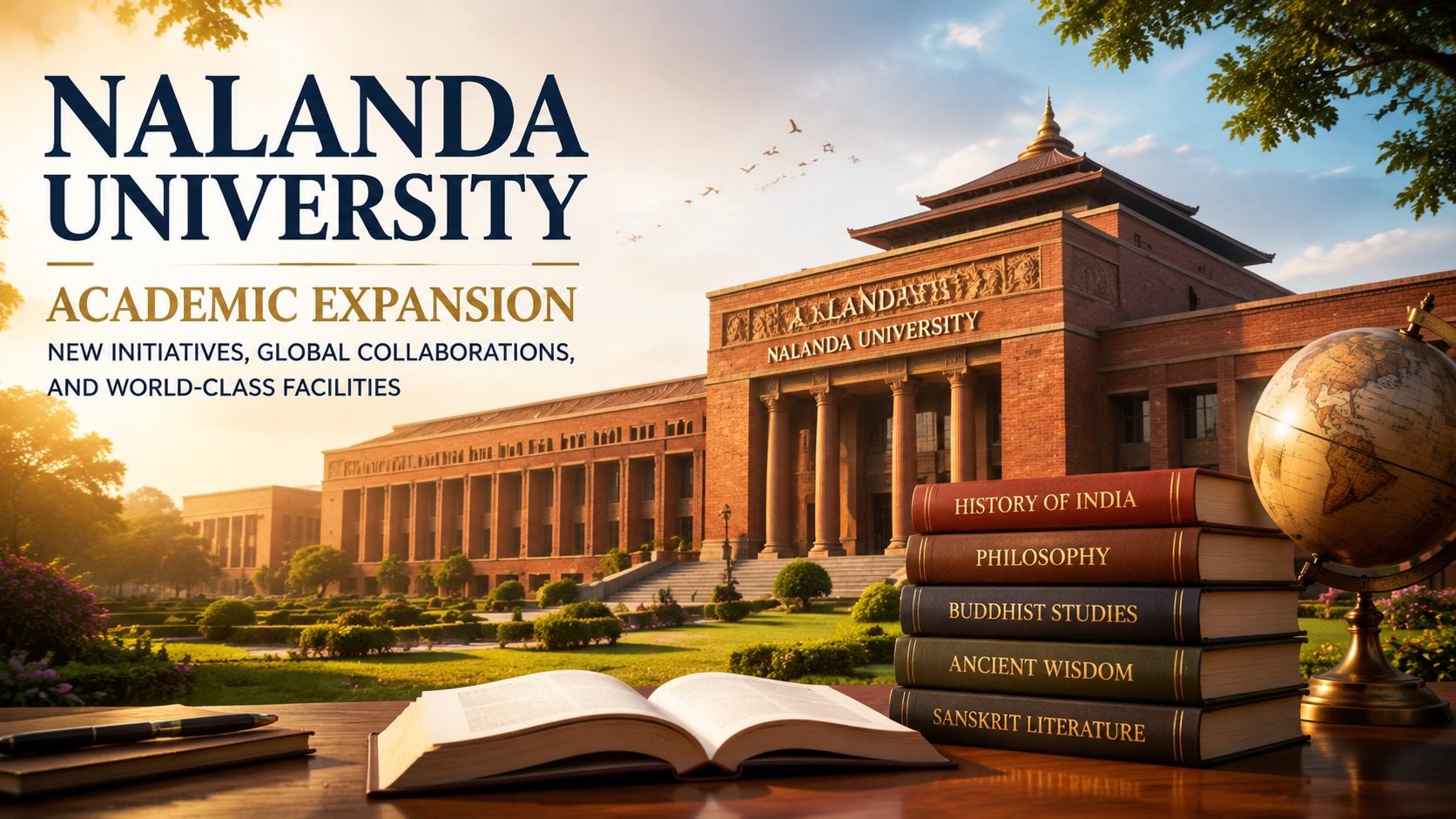
A major milestone was reached on 19 June 2024 when Prime Minister Narendra Modi inaugurated the university’s permanent campus in Rajgir. The ceremony was attended by senior government representatives, university officials, and diplomats from participating countries.
According to the Nalanda University Annual Report 2023-24 and official university disclosures (retrieved May 2026), the campus spans 455 acres and incorporates sustainability-focused infrastructure.
Campus Overview
|
Feature |
Details |
|
Campus Area |
455 acres |
|
Expenditure Incurred |
₹1,749 crore |
|
Approved Outlay |
₹2,727.10 crore |
|
Solar Capacity |
6.5 MW |
|
Water Bodies |
More than 100 acres |
|
Academic Classrooms |
40 |
|
Additional Facilities |
Auditorium, hostels, sports complex, medical centre |
Source: Nalanda University Annual Report 2023-24; Annual Accounts & Audit Report 2023-24 (retrieved May 2026).
The campus includes renewable energy systems, water conservation infrastructure, and biogas facilities as part of its sustainability strategy.
Other 2024 Developments
In February 2024, ASEAN Secretary-General Dr. Kao Kim Hourn visited the campus and delivered a lecture on regional cooperation and higher education. During the same month, Chancellor Arvind Panagariya inaugurated a medical centre for students, faculty, and staff.
Highway Project to Improve Connectivity
On 6 August 2025, Bihar Chief Minister Nitish Kumar laid the foundation stone for the Salepur-Rajgir four-lane highway project.
The project, estimated at ₹862.63 crore according to publicly reported government project information, aims to improve connectivity between Patna and Rajgir.
|
Project Detail |
Information |
|
Estimated Cost |
₹862.63 crore |
|
Project Type |
Four-lane highway |
|
Route |
Salepur-Rajgir |
|
Expected Impact |
Improved regional connectivity |
|
Beneficiaries |
Residents, tourists, educational institutions |
Improved transport links may support educational access, tourism activity, and regional development.
Governance Developments and Early Challenges
The university’s early years were marked by governance-related discussions and administrative changes.
In February 2015, founding Chancellor Amartya Sen announced that he would not seek a second term. In public statements, Sen cited concerns regarding delays in the approval process and institutional functioning.
In November 2016, former Singapore Foreign Minister George Yeo resigned as Chancellor after changes were made to the university’s Governing Board. Yeo stated that the developments raised concerns regarding institutional autonomy.
A later audit by the Comptroller and Auditor General (CAG) of India highlighted several issues relating to the institution’s early development phase.
|
Audit Observations |
|
Delays in campus construction |
|
Project implementation challenges |
|
Delayed establishment of academic schools |
|
Administrative irregularities identified in audit findings |
Why These Developments Matter
The recent developments reflect broader trends in Indian higher education, including greater emphasis on international collaboration, sustainability, and interdisciplinary research. The establishment of specialised research centres and the expansion of campus infrastructure align with national efforts to strengthen academic engagement with neighbouring regions and increase global participation in Indian universities.
The university also contributes to Bihar’s educational profile and supports regional economic activity through infrastructure and institutional development.
Sources and Verification
This article is based on:
- Nalanda University Annual Report 2023-24
- Annual Accounts & Audit Report 2023-24
- Ministry of External Affairs Annual Report
- Parliamentary records (Lok Sabha and Rajya Sabha)
- PIB releases
- CAG Audit Report No. 25 of 2023
- Official Nalanda University announcements
Source Retrieval Period: May 2026.
Reader Safety Advisory
Readers should verify university-related announcements only through official university and government channels.
- Use official websites for admissions, scholarships, recruitment, and institutional updates.
- Never share OTPs, passwords, or banking credentials.
- Avoid unofficial admission agents or third-party intermediaries.
- Verify payment requests and application notices through authorised sources before taking action.
- Report suspicious messages or fraudulent communications to the relevant authority.
Editorial Disclaimer
Information presented in this article is based on official records and public documents available as of May 2026. Institutional policies, funding allocations, academic initiatives, and infrastructure projects may change after publication. Readers are advised to consult official notifications issued by Nalanda University and relevant government authorities for the latest information. In case of any discrepancy, official notifications and government records shall prevail.
Conclusion
Nalanda University’s recent developments indicate a period of continued institutional growth marked by new research initiatives, infrastructure expansion, and international engagement. At the same time, its history reflects the administrative and governance challenges often associated with building a large international university. Readers seeking updated information should refer to official university announcements and government publications for verification.