
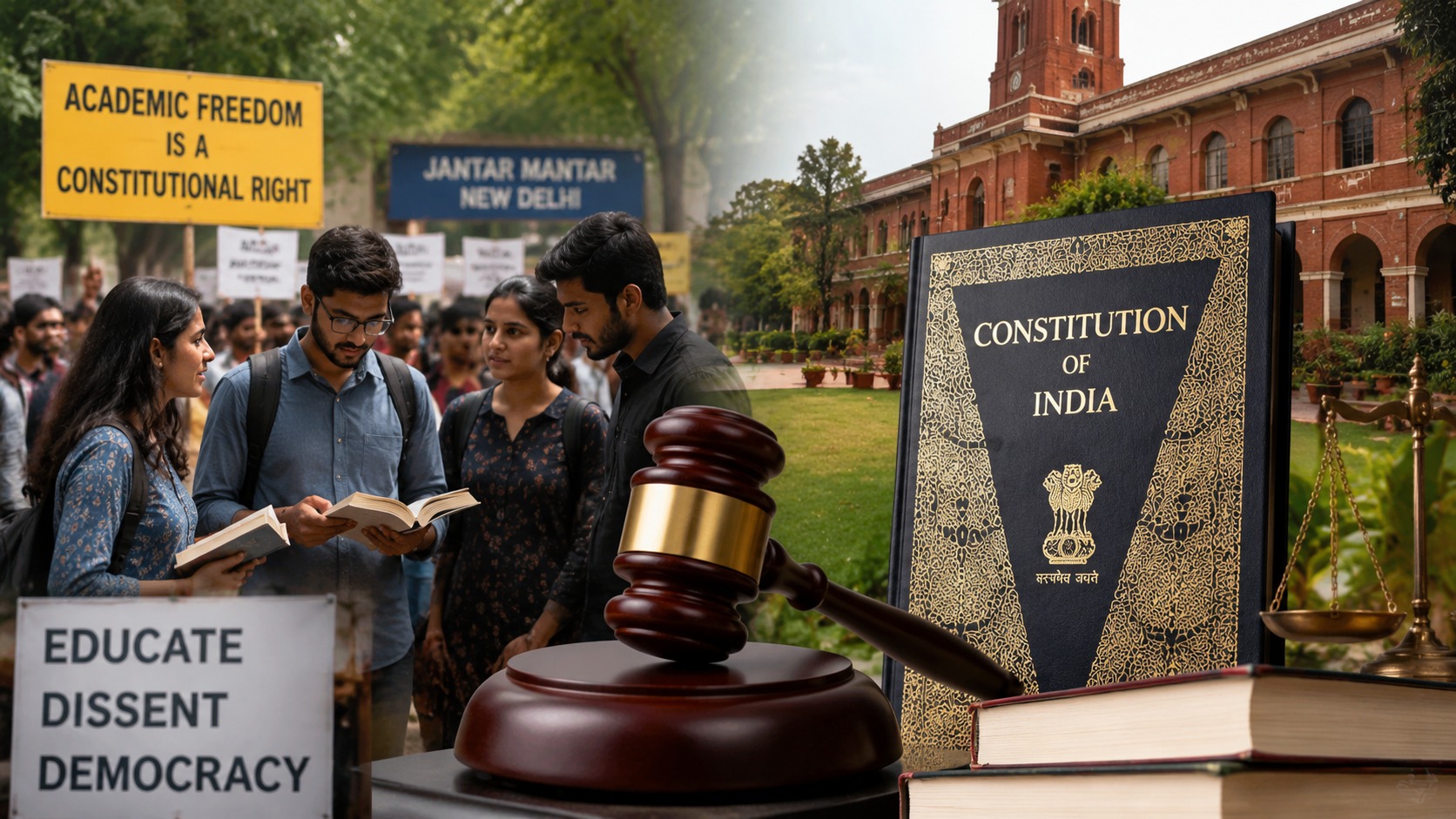
Universities Issue Advisories on Jantar Mantar Protests, Prompting Debate on Campus Governance and Student Rights
Last Updated: 24 July 2026
Several higher education institutions, including Jawaharlal Nehru University (JNU), Delhi University (DU), IIT Roorkee, IIT Madras, and the Association of Indian Universities (AIU), have issued advisories asking students, faculty members, and staff to avoid participating in the ongoing protests at Jantar Mantar in New Delhi. According to the institutions, the advisories are intended to promote safety, maintain campus discipline, and ensure compliance with applicable laws and institutional regulations.
The advisories have generated discussion among students, educators, legal experts, and political leaders over the balance between institutional responsibilities and the constitutional right to peaceful expression. The issue has also drawn attention to recent judicial observations concerning the scope of disciplinary action against students participating in peaceful protests.
Overview of Institutional Advisories
| Institution | Advisory Highlights |
|---|---|
| JNU | Asked students, faculty, and staff to avoid gatherings near Jantar Mantar, citing safety concerns and applicable legal directions. The notice stated that violations could attract legal and disciplinary action under university regulations. |
| Delhi University | Advised against participation in unlawful assemblies and cautioned that legal proceedings could affect academic records and future career opportunities. It also urged caution against misinformation circulating on social media. |
| IIT Roorkee | Issued guidance discouraging political social media activity that could affect institutional interests. The institute later clarified that the advisory forms part of its routine code of conduct and was not introduced specifically for the ongoing protests. |
| IIT Madras & AIU | Similar advisories have been reported, emphasising safety and adherence to institutional rules. |
Institutional Position
Delhi University stated that involvement in unlawful demonstrations may have legal consequences and advised students to verify information before sharing or acting on content circulated online. The university highlighted concerns over misinformation and manipulated media that could influence public perception during the ongoing developments.
Separately, JNU issued its advisory on 24 July 2026, requesting members of its academic community to avoid gatherings around Jantar Mantar. The notice referred to safety considerations and reminded students to follow the university’s code of conduct, including responsible use of social media.
IIT Roorkee also clarified that its advisory was a standard communication circulated under existing conduct rules at the beginning of academic sessions and should not be interpreted as a newly introduced restriction linked solely to the current protests.
Reactions to the Advisories
The advisories have received differing responses. Some university administrations have described them as precautionary measures intended to protect students and maintain institutional order.
At the same time, several student organisations, teachers’ groups, and opposition leaders have questioned whether such advisories could discourage peaceful democratic participation. The JNU Teachers’ Association (JNUTA) has indicated that it will discuss the matter internally, while public debate continues regarding the appropriate balance between campus governance and constitutional freedoms.
Delhi High Court Judgment in Context
The discussion has also referenced a March 2026 judgment of the Delhi High Court concerning disciplinary action taken against a student of Dr. B.R. Ambedkar University.
According to reports of the judgment, the Court observed that universities, as public institutions, should not restrict peaceful protest solely because of ideological differences. It also emphasised that disciplinary measures must satisfy the principle of proportionality and recognised the role of universities in encouraging dialogue, critical thinking, and academic debate.
The judgment is being cited in public discussions surrounding the legal scope of institutional action in similar situations. Readers should refer to the official court order for the complete legal reasoning.
Why the Issue Matters
The developments extend beyond a single protest and raise broader questions about campus administration, student welfare, institutional autonomy, and constitutional rights. As universities continue to review their responsibilities during public demonstrations, the issue remains significant for students, higher education institutions, policymakers, and legal experts across the country.
Verification Advisory
Readers are advised to rely only on official notices published by the respective universities and authorised government or judicial sources. Social media posts, screenshots, forwarded messages, and unofficial summaries should not be treated as authentic unless they match the information available through verified institutional channels.
Official Sources for Verification
- Official notices published by JNU, Delhi University, IIT Roorkee, IIT Madras, and AIU.
- Orders and judgments available through the Delhi High Court.
- Official press releases and verified communications issued by the concerned institutions.
Editorial Disclaimer
This article is based on information available as of 24 July 2026. University advisories, administrative decisions, legal proceedings, and court interpretations may change over time. Readers should verify the latest information through official university notifications and judicial records, which take precedence over this article.